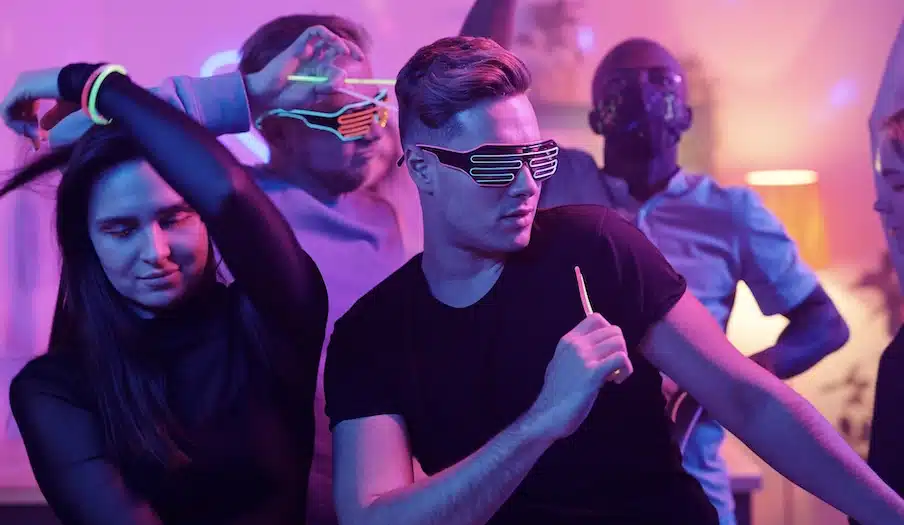
Instead of a select few being included in a major live event’s visuals, thousands of concertgoers might find themselves part of the light show, as wristbands blink in time with music and video screens. While it might seem magical, these spectacles are made possible by a complex interplay of wireless systems, lighting consoles and software, and well-executed programming.
How DMX Controls Concert Lighting
DMX512 is a standard digital communication protocol used in the entertainment industry, most often for stage lighting. It allows a lighting console to control a light’s luminance (intensity), as well as its color, gobos, effects, and position.
For synchronized wristbands, the lighting system includes a DMX-based transmitter that connects all the wristbands wirelessly via built-in receivers. The lighting control sends command signals to the transmitter, which, in turn, sends signals to the wrists of the audience members who wear the wearable.
Different systems use different ways of transmitting data, such as radio frequency (RF) or others. Signals can be tailored to individual wearables, allowing different pockets of the crowd to light up with different synchronized colors or patterns.
Turning the Audience Into a Light Display
It’s when the show begins that the magic really starts. By programming their show, lighting designers can match the wristbands’ effect to the music or video content on stage. The result is an immersive, audience-wide spectacle where lights, music, and performance work together as one.
Entire audience sections can be bathed in a gentle blue during a ballad before an epic chorus sees the whole venue’s wristbands flashing red. Bands all around the audience area can also be given different effects, creating rippling lightbands that flow throughout the crowd.
To do this takes meticulous planning. Designers have to take into account the size of the venue, signal range and strength of the wireless system, and design effects that change in time with the music or visuals. When thousands of units have to respond at once, getting the right crowd effect takes constant, clear communication.
The Technology Behind Wireless Wristbands
Contemporary LED wristbands contain a unit of compact electronics, light-emitting diodes, batteries, and a wireless receiver. In some devices, individual or group wristbands can receive different messages, and other devices focus on mass synchronisation.
For event organisers, glow wristbands for concerts Europaband represents a way to expand the ambient lighting beyond the boundaries of the stage and engage the audience directly in the activity. Such devices can also serve as souvenirs of a music event and add a new dimension to the concert.
What Comes Next for Concert Lighting?
As wireless control systems and event production technology continue to develop, audience participation is becoming an increasingly important part of live entertainment. Synchronized wristbands demonstrate how relatively small wearable devices can contribute to an enormous visual display.
By combining lighting protocols, wireless communication and creative programming, concert designers can transform a crowd into an active part of the show, creating shared moments that extend well beyond the music itself.