If you run a startup in 2026, you have probably heard three acronyms in the same meeting: SEO, AEO and GEO. Each comes with a vendor, a deck and a sense of urgency. I work as an SEO, GEO and AEO consultant, and the question founders ask me most is which one to fund first. Most early teams can afford one properly, not three.
The pressure is real. Google says AI Overviews now reach more than 2.5 billion people a month, and ChatGPT passed 900 million weekly users early this year. Yet SE Ranking found that AI assistants sent just 0.32% of all website traffic in 2026, against 42.75% from organic search.
After 18 years in search, my answer is simple. Don’t choose. Sequence. The three overlap far more than the pitches suggest, and the order of the work matters more than its label.
SEO, AEO and GEO in plain English
SEO gets your pages crawled, indexed and ranked. AEO, or answer engine optimization, shapes pages so a search engine or assistant can lift a direct answer from them. GEO, or generative engine optimization, raises the odds that ChatGPT, Perplexity, Gemini and Google’s AI Mode mention or cite your brand.
In practice, they share one foundation. Google’s guide to optimizing for generative AI search, published in May 2026, says AI Overviews and AI Mode pull pages from the same index and ranking systems as regular results. From Google’s side, it says, this work “is optimizing for the search experience, and thus still SEO.” ChatGPT works the same way. OpenAI’s crawler documentation says sites that block OAI-SearchBot will not be shown in ChatGPT search answers.
The difference that matters is where the work happens. SEO and AEO live mostly on your own site, so you control them. GEO lives mostly off-site, in what reviewers, communities and publications say about you. That sets the order.
The answer is a sequence, not a choice
Each layer depends on the one beneath it. An AI engine cannot cite a page it cannot crawl, lift an answer you never wrote or recommend a brand nobody else mentions. So the 90 days run in that order: fix what every engine reads, publish the answers buyers want, then earn mentions where AI models look.
Days 1-30: fix what every engine reads
This month is unglamorous, and it has the highest payoff.
- Confirm your key pages are indexed. Verify the site in Google Search Console and Bing Webmaster Tools. Google’s guide says a page must be indexed and eligible for a snippet before it can appear in AI Overviews or AI Mode. Also check the Search Console setting that includes your site in generative AI features.
- Check which AI crawlers you block. Read your robots.txt, then your CDN settings. Cloudflare blocks known AI crawlers by default on new domains, and since September 15, 2026, its defaults also block training and agent crawlers on pages that show ads. Cloudflare says that if you block training there, multi-purpose crawlers such as Googlebot and Bingbot get blocked too. Allow the search crawlers you want, such as OAI-SearchBot and PerplexityBot, and make the training decision on purpose.
- Make your company easy to describe. Use one name and one plain sentence about what you do and for whom on your homepage, About page, LinkedIn, Crunchbase and review profiles. Add Organization schema that links those profiles. Google says it isn’t required for AI features, but it takes an hour.
- Test a real task, not just a score. In September, my own site, nirlevi.com, scored 2/2 on Lighthouse’s Agentic Browsing audit and 20 out of 100 on Cloudflare’s Agent Readiness check. Then I ran a controlled test of the contact form. A three-letter message padded with spaces passed the browser’s length check, but the server trimmed and rejected it. Rejecting it was correct. Telling the visitor that sending had failed, with no reason, was the bug, and neither score caught it. I documented the full test and the fix. Pick the one action that makes you money, such as a signup or a demo request, and run it end to end with messy inputs.
Days 31-60: answer the questions buyers ask (AEO)
Start with your sales calls, not a keyword tool. List the 20 to 30 questions prospects ask before they buy, about price, fit, alternatives, integrations and switching.
Answer each one on a page built for it, with the answer in the first sentence and the proof after it. For most startups, that means:
- A pricing page with real numbers or ranges
- Comparison pages against the two or three tools buyers name most often
- Use-case pages written in the customer’s own words
- Integration and migration pages
Keep it first-hand. Google’s guide says unique, useful content will likely shape your AI visibility more than anything else it recommends, and it contrasts generic tip lists with pages built on real experience. Your customer data, benchmarks and failures are material no competitor can copy.
The long tail works in your favor. Semrush found that more than 68% of keywords that trigger AI Overviews get 100 or fewer searches a month. Big brands ignore those queries, which gives a young site a fair chance.
One warning: don’t create a page for every phrasing of a question. Google says mass-producing pages to chase related queries can violate its scaled content abuse policy.
Days 61-90: earn mentions where AI looks (GEO)
Now the work moves off your site. An Ahrefs study of 75,000 brands found that branded web mentions had the strongest correlation with appearing in AI Overviews, at 0.664. Domain Rating correlated at just 0.326. Brands in the top quartile for web mentions earned up to 10 times more AI Overview mentions than the next quartile down.
For a startup, mentions come from a short list of places: review sites such as G2 and Capterra, “best tools for X” roundups that already rank, podcasts and newsletters your buyers follow, and communities where you answer questions under your own name.
To find targets, write 20 prompts your buyers would type, such as “best [category] for [type of company]” or “[your product] vs [competitor]”. Run them in ChatGPT, Perplexity, Gemini and Google’s AI Mode, and note which sources each answer cites. Those pages are your outreach list.
Keep it real. Google’s guide warns that chasing inauthentic mentions is less helpful than it looks, because its AI features rely on the same systems that filter spam. Fake reviews and planted forum posts are a liability, not a shortcut.
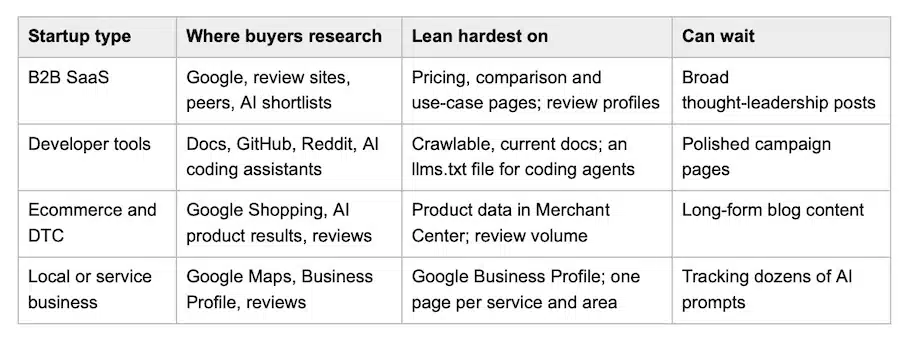
How to weight the plan for your type of startup
The sequence holds for everyone. The emphasis shifts with where your buyers research.
What to ignore for now
- llms.txt as a Google tactic. Google says Search ignores these files. They still help coding agents read developer docs.
- Chunking or rewriting content for AI. Google says its systems need neither.
- Tools that promise inside knowledge. Google says no third-party tool has access to its ranking or AI systems.
- The famous “40%” GEO number. The 2023 GEO research paper reported visibility gains of up to 40%, but it tested edits to pages already retrieved for a query. It says little about getting retrieved in the first place, which is the hard part for a new brand.
How to tell if it is working
Take a baseline in week one, then measure monthly.
- Search Console. The Generative AI performance report, launched in June 2026, shows your impressions in AI Overviews and AI Mode. It has no click data, so read it next to the main Performance report. Bing Webmaster Tools has a similar AI Performance dashboard.
- Analytics referrals. Segment sessions from chatgpt.com, perplexity.ai, gemini.google.com and copilot.microsoft.com. Judge them by conversions, not volume. In June 2025, Ahrefs reported that AI search sent 0.5% of its visitors but 12.1% of its signups.
- Your prompt set. Rerun the same 20 prompts each month and track how often you are mentioned.
- Branded search. More people searching for your name is an early sign that mentions are working.
By day 90, you will know which pages earn AI impressions, which prompts you appear in and which sources keep getting cited. That is where next quarter’s budget should go.
Start with the floor
SEO is the floor, AEO is the answers and GEO is your reputation. Skip the floor and the other two have nothing to stand on. Build them in that order, measure every month and ignore anyone selling a hack.