
The digital landscape for law firms is constantly evolving. In September 2026, artificial intelligence (AI) is fundamentally reshaping how potential clients search for legal services. Traditional search engine optimization (SEO) is no longer enough. The rise of AI-powered search results means law firms must adapt their digital strategies to remain visible and competitive.
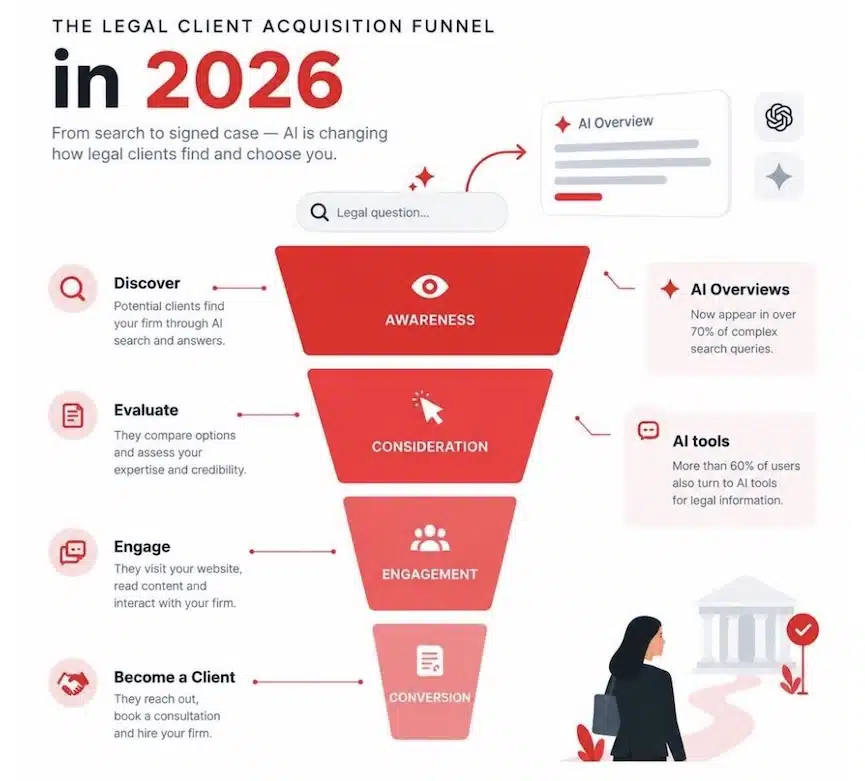
Google AI Overviews now appear in over 70% of complex search queries. This represents a significant shift from how users previously found information. More than 60% of users also report turning to AI tools like ChatGPT and Perplexity for informational searches. This new reality demands a fresh approach to online visibility.
This comprehensive guide explores the critical importance of AI Overview Optimization for lawyers. We will dive into how AI Overviews differ from traditional search results and why this matters for your firm’s online presence. We will also share actionable strategies to help your firm appear prominently in these AI-generated answers.
Our goal is to equip you with the knowledge and tools needed to thrive in this new era. We will cover everything from content structuring and technical SEO to E-E-A-T signals and measurement. Understanding these changes is vital for effective lead generation and case acquisition in today’s legal market.
The digital realm has always been a dynamic space, and for law firms, staying ahead means constantly adapting to new technologies and user behaviors. In 2026, we are witnessing a profound transformation driven by artificial intelligence. This shift impacts everything from search intent to conversion rates, fundamentally altering the landscape for legal leads.
The traditional client acquisition funnel, while still relevant in its core principles, is now heavily influenced by generative engines and the rise of zero-click search. Understanding these changes is paramount for any law firm aiming to maintain or improve its online visibility and attract new clients.
The Evolution of Digital Marketing for Law Firms in the AI Era
Digital marketing for law firms has always been about visibility and trust. Historically, this meant optimizing for traditional search engine results pages (SERPs) through SEO, aiming for top rankings that would drive traffic to our websites.
However, the introduction of AI Overviews by Google, alongside the growing popularity of answer engines like Perplexity and ChatGPT, has ushered in a new paradigm.
These AI-powered interfaces often provide direct answers to complex legal inquiries, synthesizing information from multiple sources. This evolution necessitates a strategic pivot from purely traditional SEO to a more comprehensive Generative Engine Optimization (GEO) approach.
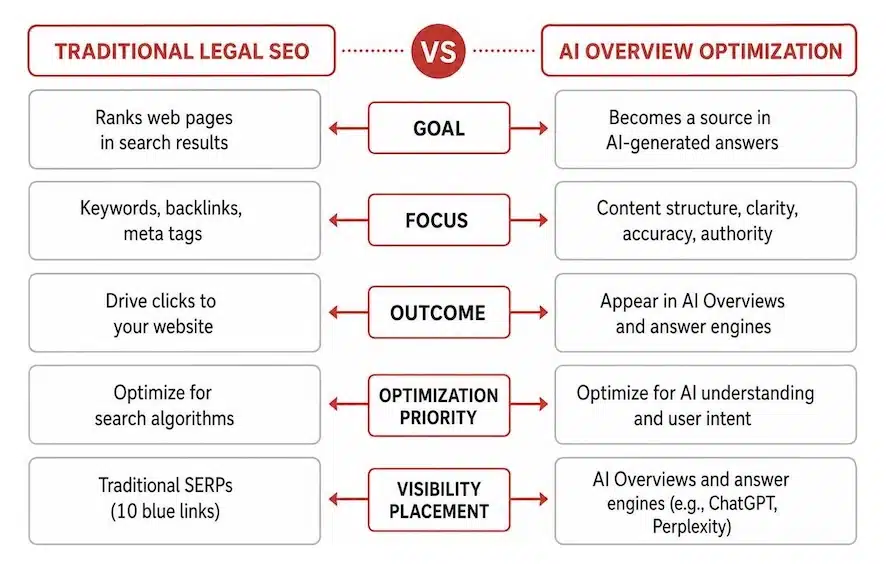
The distinction between traditional SEO and AI Overview optimization is crucial for law firms to grasp. While both aim for online visibility, their methodologies and desired outcomes diverge significantly.
Traditional SEO focuses on keywords, backlinks, and technical site health to rank web pages. AI Overview optimization, on the other hand, prioritizes content structure, clarity, accuracy, and authoritative signals to be chosen as a source for AI-generated answers.
Core Channels in Modern Digital Marketing for Law Firms
Even with the rise of AI, several core digital marketing channels remain foundational for law firms. Organic search continues to be a primary driver of traffic, with potential clients actively seeking legal information and services. Local SEO is particularly vital for firms serving specific geographic areas, ensuring visibility in local pack results and Google Business Profile listings.
To succeed in this environment, law firms must build robust topic clusters around their practice areas, creating comprehensive content that addresses all facets of a legal subject. This not only signals expertise to search engines but also provides in-depth resources for users.
Implementing schema markup, such as Legal Service and FAQ Page schema, helps search engines and AI understand the context and purpose of our content. Furthermore, maintaining a strong presence in reputable legal directories and optimizing for efficient client intake triage are essential for converting online interest into actual cases.
The Shift Toward AI Answer Engines and Conversational Search
The emergence of AI answer engines and conversational search represents a significant shift in how users interact with information. Instead of browsing a list of links, users are increasingly posing conversational queries directly to AI tools.
These tools, whether Google’s AI Overviews, ChatGPT, or Perplexity, are designed for multi-source synthesis, pulling information from various websites to construct a direct, concise answer.
For law firms, this means that the goal is no longer just to rank highly, but to be the authoritative source that an AI chooses to cite. This requires content that is not only accurate and comprehensive but also structured in a way that is easily digestible by AI models.
Q&A formats, clear headings, and concise summaries become paramount. When an AI tool directly cites our firm’s content, it provides a powerful endorsement of our expertise and can significantly enhance our reputation and visibility in this new search landscape.
High-Impact Content and Technical Strategies for Client Acquisition
To truly excel in AI Overview optimization, law firms must adopt a dual approach that combines high-quality, strategically structured content with robust technical SEO. This synergy ensures that our valuable legal insights are not only discoverable by search engines and AI but also presented in a format that encourages citation and direct answers.
From the foundational elements of content architecture to the technical underpinnings of crawlability and mobile performance, every aspect plays a role in attracting and converting potential clients.
Building Authoritative E-E-A-T and Practice Area Hubs
In the age of AI Overviews, E-E-A-T (Experience, Expertise, Authoritativeness, and Trustworthiness) signals are more critical than ever, especially in the legal sector where accuracy and reliability are paramount.
Law firms must actively demonstrate these qualities to both human users and AI models. This means prominently featuring author credentials, including bar admissions, years of practice, and relevant legal specializations. We should integrate real-world case studies (while maintaining client confidentiality) to showcase practical experience and successful outcomes.
Citation accuracy is non-negotiable. All legal information, statutes, and precedents mentioned in our content must be meticulously referenced to primary sources. This not only builds trust with readers but also signals to AI that our content is well-researched and verifiable.
Editorial transparency, including clear policies on content creation and review, further reinforces our commitment to accuracy.
Developing comprehensive practice area hubs, often structured as pillar pages, is an effective way to establish authority. These extensive resources cover a broad legal topic in depth, linking out to more specific sub-topics (cluster content). This architecture signals to search engines and AI that our firm is a definitive source of information for that particular legal field.
Technical SEO and Structured Data Optimization
Beyond content, the technical foundation of a law firm’s website is crucial for AI Overview success. Implementing schema markup, particularly legal service schema, is essential.
This JSON-LD code helps search engines understand that our business provides legal services, including specific practice areas, locations, and contact information. FAQ Page markup can be used to explicitly structure questions and answers on our site, making it easier for AI Overviews to extract direct answers to common queries.
Crawl budget optimization ensures that search engine bots efficiently discover and index all our important content. This involves maintaining a clean site structure, using clear internal linking, and avoiding duplicate content.
Core Web Vitals – encompassing page speed, interactivity, and visual stability – directly impact user experience and are increasingly important ranking factors for both traditional search and AI Overviews.
With 53% of mobile users leaving a site if it takes over 3 seconds to load, optimizing page speed is critical. Finally, ensuring mobile responsiveness is non-negotiable, as a significant portion of legal searches occur on mobile devices.
Multi-Channel Lead Generation and Conversion Optimization
Attracting potential clients through AI Overviews and traditional search is only half the battle; converting those leads into actual cases requires a sophisticated multi-channel approach and relentless focus on conversion optimization. In 2026, law firms cannot afford to overlook any part of the client journey, from initial inquiry to final retention.
Measuring ROI from Digital Marketing for Law Firms
To truly understand the effectiveness of our digital marketing efforts, rigorous measurement of ROI is indispensable. This involves tracking key metrics such as cost per acquisition (CPA) for various channels, realization rates (the percentage of billable hours that are actually collected), and referral tracking to identify the most valuable sources of new business.
Conversion rate optimization, which focuses on improving the percentage of website visitors who complete a desired action (e.g., filling out a contact form, calling the office), is critical.
Attribution modeling helps us understand which touchpoints in the client journey contributed to a conversion, allowing for more informed budget allocation. Utilizing analytics dashboards that integrate data from our website, CRM, and intake systems provides a holistic view of performance.
Firms with a visible AI strategy were twice as likely to experience revenue growth and nearly four times more likely to see measurable ROI in 2025, underscoring the importance of strategic investment and measurement. This includes understanding the impact of AI-driven efficiencies, such as legal teams using AI to reduce contract review time by 45-90%, which directly contributes to improved realization rates.
Common Mistakes That Diminish Law Firm Marketing ROI
Even with the best intentions, law firms can make critical errors that undermine their digital marketing ROI. One significant pitfall is the rise of “shadow AI” use, where individual attorneys use generative AI tools without firm-wide policies or oversight. This can lead to ethical breaches, data privacy concerns (41% of American lawyers report data privacy concerns as their primary barrier to AI adoption), and inconsistent output.
Other common mistakes include:
- Boilerplate Content: Generic, unoriginal content that fails to establish expertise or address specific user needs will not be cited by AI Overviews or rank well in traditional search.
- Missing Schema Markup: Failing to implement appropriate schema prevents search engines and AI from fully understanding our content’s context and relevance.
- Unverified Citations: Relying on AI-generated information without human verification, especially for legal citations, can lead to serious ethical and professional repercussions, as seen in cases where lawyers were sanctioned for submitting briefs with fabricated cases.
- Slow Intake Processes: Even the best lead generation efforts are wasted if the firm’s intake process is slow or inefficient. Potential clients expect rapid responses.
- Generic Landing Pages: Landing pages that are not highly relevant to the specific search query or ad campaign will result in high bounce rates and low conversion.
By avoiding these pitfalls and focusing on data-driven strategies, law firms can significantly enhance their lead generation and conversion efforts in the AI era.
Multi-Channel Lead Generation and Conversion Optimization

Measuring ROI from Digital Marketing for Law Firms
To truly understand the effectiveness of our digital marketing efforts, rigorous measurement of ROI is indispensable. This involves tracking key metrics such as cost per acquisition (CPA) for various channels, realization rates (the percentage of billable hours that are actually collected), and referral tracking to identify the most valuable sources of new business.
Conversion rate optimization, which focuses on improving the percentage of website visitors who complete a desired action (e.g., filling out a contact form, calling the office), is critical.
Attribution modeling helps us understand which touchpoints in the client journey contributed to a conversion, allowing for more informed budget allocation. Utilizing analytics dashboards that integrate data from our website, CRM, and intake systems provides a holistic view of performance.
Firms with a visible AI strategy were twice as likely to experience revenue growth and nearly four times more likely to see measurable ROI in 2025, underscoring the importance of strategic investment and measurement.
This includes understanding the impact of AI-driven efficiencies, such as legal teams using AI to reduce contract review time by 45-90%, which directly contributes to improved realization rates.
Common Mistakes That Diminish Law Firm Marketing ROI
Even with the best intentions, law firms can make critical errors that undermine their digital marketing ROI. One significant pitfall is the rise of “shadow AI” use, where individual attorneys use generative AI tools without firm-wide policies or oversight. This can lead to ethical breaches, data privacy concerns (41% of American lawyers report data privacy concerns as their primary barrier to AI adoption), and inconsistent output.
Other common mistakes include:
- Boilerplate Content: Generic, unoriginal content that fails to establish expertise or address specific user needs will not be cited by AI Overviews or rank well in traditional search.
- Missing Schema Markup: Failing to implement appropriate schema prevents search engines and AI from fully understanding our content’s context and relevance.
- Unverified Citations: Relying on AI-generated information without human verification, especially for legal citations, can lead to serious ethical and professional repercussions, as seen in cases where lawyers were sanctioned for submitting briefs with fabricated cases.
- Slow Intake Processes: Even the best lead generation efforts are wasted if the firm’s intake process is slow or inefficient. Potential clients expect rapid responses.
- Generic Landing Pages: Landing pages that are not highly relevant to the specific search query or ad campaign will result in high bounce rates and low conversion.
By avoiding these pitfalls and focusing on data-driven strategies, law firms can significantly enhance their lead generation and conversion efforts in the AI era.
Frequently Asked Questions About Legal Digital Marketing
How do AI Overviews impact legal search traffic?
AI Overviews fundamentally change how users interact with search results, leading to both challenges and opportunities for legal practices. They provide concise, synthesized answers directly on the search results page, often reducing the need for users to click through to individual websites.
This phenomenon, known as “zero-click searches,” can decrease traditional organic traffic to law firm websites. However, AI Overviews also offer a new avenue for visibility: being cited as a source. If our content is deemed authoritative and relevant enough to be included in an AI summary, it gains a powerful endorsement.
Research shows roughly 76% of AI Overview citations come from pages ranked 1 to 10 in traditional search, emphasizing the continued importance of strong foundational SEO. For law firms, the goal shifts from merely getting a click to being the definitive source that an AI references, enhancing our brand’s authority and top-of-mind awareness.
What is the most effective digital channel for legal leads?
While the “most effective” channel can vary based on practice area and target audience, a multi-faceted approach centered around organic search and Google Business Profile optimization consistently yields high-quality legal leads.
Organic search, particularly for informational queries, allows firms to capture users early in their legal research journey. Local pack results, driven by strong Google Business Profile optimization, are crucial for capturing geographically specific searches.
Conversational search, facilitated by AI Overviews and answer engines, is rapidly growing in importance for both informational and direct service inquiries. Additionally, robust referral networks, both online and offline, remain a powerful source of qualified leads. The key is not to rely on a single channel but to integrate these efforts, ensuring a seamless user experience across all touchpoints.
How quickly should a law firm follow up with digital leads?
The speed of lead follow-up is a critical factor in conversion, especially in the legal industry where potential clients are often in urgent need of assistance. Studies consistently show that the quicker a lead is contacted, the higher the conversion rate. Ideally, law firms should aim for immediate follow-up, within minutes if possible.
This can be facilitated through automated scheduling tools that allow prospective clients to book consultations directly after submitting an inquiry. Rapid response demonstrates professionalism and responsiveness, which are highly valued by clients.
Delayed follow-up, even by a few hours, can significantly reduce the likelihood of conversion, as clients may move on to another firm that responds more promptly. Firms with structured AI enablement see 72% higher adoption rates of efficient processes, including client intake, which directly impacts this crucial response time.
Conclusion
The digital marketing landscape for law firms in 2026 is complex, yet ripe with opportunity for those willing to adapt. The rise of AI Overviews and generative search engines demands a strategic roadmap that goes beyond traditional SEO, focusing on content authority, technical excellence, and efficient lead conversion.
By prioritizing E-E-A-T signals, structuring content for AI consumption, implementing robust technical SEO, and optimizing intake workflows, law firms can significantly enhance their digital visibility and attract more qualified inquiries. This proactive approach to AI Overview optimization is not just about staying competitive; it’s about building a sustainable foundation for growth in an increasingly AI-driven legal market.